Case study: Unified Agent Memory
From isolated agentic sessions and tools to one shared memory hub.
Product designer, Builder

Overview
Coding agents forget everything between sessions, and the obvious fix — more context, more retrieval — makes them slower, costlier, and leakier.
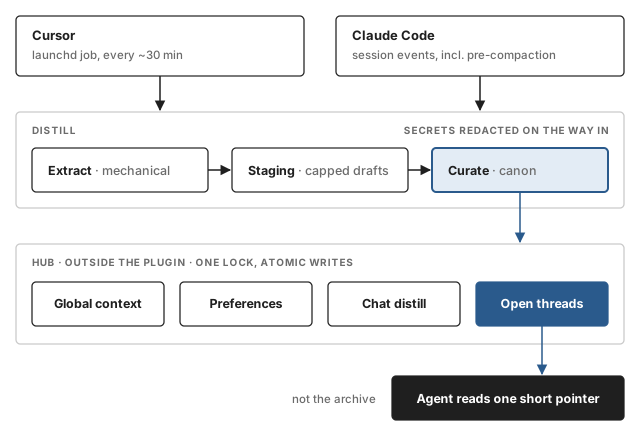
Agent Memory started as an experiment in persistent memory for local coding environments. After 23 releases, it connects Cursor and Claude Code through a shared, layered memory system, with an open connector interface for other agents.
The problem
Coding agents start every session blank and don’t see each other. Project rules help inside one repo, but they don’t carry what actually compounds across work: cross-project conventions, approaches already rejected, the distilled shape of long threads, and where we stopped yesterday across five checkouts.
The obvious fix — loading the transcripts — fails on three counts. It’s slow, expensive in context, and leaks secrets by default.
The idea was to build memory as an editorial desk, not a vector store. The goal is to route a small, correct slice of context to the agent at the right moment: read the index first, choose a layer explicitly, and rotate content out when a layer hits its size limit.
My role and constraints
I owned the whole loop: the product model, the information architecture of the hub, the distill pipeline, the plugin code, migrations and releases. No PM, no separate engineering team — so every design call had to survive its own implementation cost.
The constraints that shaped the work:
- Support multiple environments with different contracts. Claude Code fires real session events; Cursor dropped hook support mid-2026 and can only run on a schedule. Other agents can have their own rules.
- Public repo, private data. The framework is open source; the memory it holds is personal and must never leak.
- Zero ops. No database, no hosted service, no embedding pipeline to maintain.
- Context is the scarce resource. Every token the agent reads from memory is a token not spent on the task.
Principles
- Overview first. The agent reads a short summary and goes into details only when the task needs them. Fewer tokens without slowing it down.
- Always know where we stopped. Every session starts from what we’re working on and where we left off.
- No database. Memory is plain files you can read, diff and fix by hand. Nothing to host or maintain.
- No secrets in memory. Sensitive data is removed before anything is saved, so the agent never sees it.
Key decisions
Most of the version history is a sequence of deliberate rollbacks. Each decision below names what I tried first, why it broke, and what I accepted in exchange.
1. Layers instead of a dump
Context. Agents given the whole memory read none of it well.
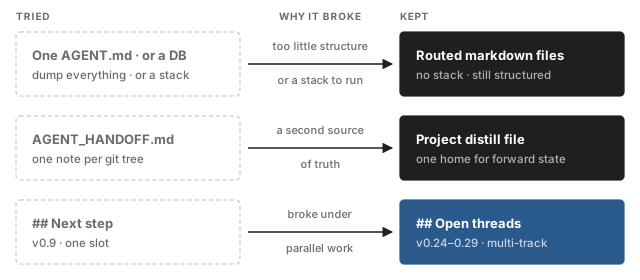
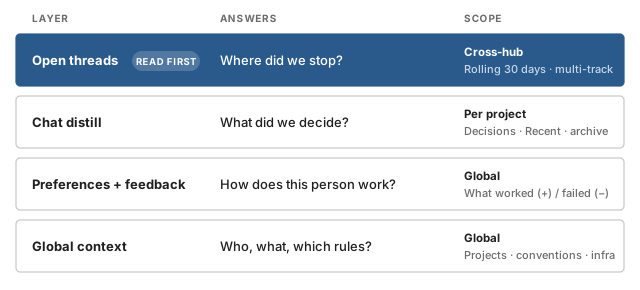
Decision. Split memory into layers that each answer one question, entered through an INDEX. Open threads is the forward pointer and is read before Decisions and Recent.
Cost. The agent needs routing discipline every session, enforced through skills and rules.
2. Routed files instead of one AGENT.md — or a database
Context. Three architectures competed: a single markdown the agent always loads; a set of files with an INDEX and layers; or something heavier — a database, embeddings, a service to keep running.
Decision. The middle path. Markdown files in a hub: structured enough to route, simple enough to audit and diff, with no stack to stand up. Effectiveness had to come from editorial structure, not from infra.
Cost. Weaker paraphrase recall than a vector store. The system stays local, inspectable, and cheap to run.
3. Distill-first, not a handoff file per repo
First attempt. An AGENT_HANDOFF.md in every git tree. It looked humane.
Why it broke. It created a second source of truth that drifted from the hub.
Decision. Forward state lives in one place: the project’s distill file.
4. Open threads replace a single Next step
First attempt. One ## Next step line — the landing-page CTA of memory.
Why it broke. Real work forks into parallel tracks; one slot forced the agent to forget the others.
Decision. ## Open threads: multi-label, a 30-day window, visible across the whole hub.
Cost. Harder to keep tidy than one line, and harder for the agent to choose from.
5. Staged curation instead of auto-summaries
First attempt. Full automatic summaries written straight into durable Decisions. They scored badly.
Decision. A staged contract: extraction and staging are mechanical; semantic merge and pointer curation are where meaning becomes canon. Guardrails keep drafts in their place:
[extracted]entries are capped, with FIFO rotation into the archive[auto]Open threads never overwrite curated ones — at most one per project, hidden after 14 days
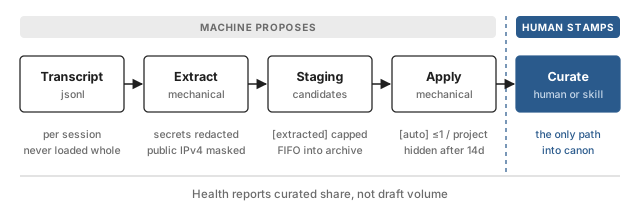
Cost. A staging backlog and real semantic-merge work.
6. Multiple writers, one hub
Context. Cursor lost hooks mid-2026 and runs continuity on a periodic job. Claude Code still fires session events, including one before context compaction.
Decision. Environment modules feed one shared hub through the same lock and atomic writes.
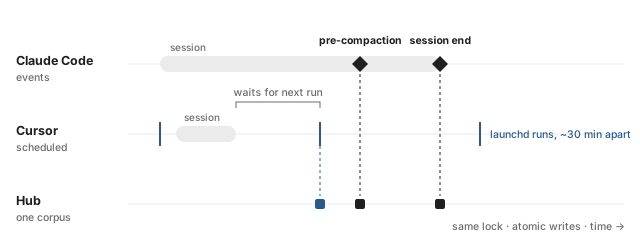
Cost. Uneven freshness: Cursor can lag by one cron interval. The corpus stays single.
7. Privacy by construction
Decision. Sensitive data is stripped at distill — before anything reaches the hub or the index the agent reads. Secrets, credentials and other sensitive values never become memory; they are filtered out of the session extract, so routing and search only see what is safe to keep.
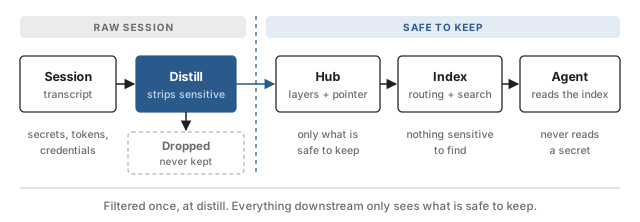
Cost. Aggressive redaction can drop useful context along with the secret. The trade-off is intentional: a smaller, safer memory beats a complete one that leaks.
8. Search without a database
Decision. Given files, search stays on files: BM25-lite over markdown, with archive and optional deep extracts at lower weight. No embeddings, no external service.
Cost. Weaker paraphrase recall. In return: full auditability and zero ops — enough for “what did we decide?” and “where did we stop?”
Measuring trust
I replaced coverage with two narrower signals, because a dashboard full of green drafts would have taught me to optimise drafts.
- Curated share. Health reports how much of memory is human-curated, not how much the extractor produced.
- Pointer effect. Did the agent actually use what memory surfaced in that session?
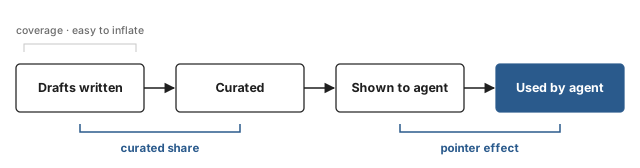
If the metric lies, the team optimises the lie. A narrow honest signal is worth more than a broad flattering one.
Trade-offs at a glance
| We chose | We paid |
|---|---|
| Small layers and routing | Skill and rule discipline every session |
| Curation over full automation | Staging backlog; semantic-merge work |
| Multi-track Open threads | Harder to maintain than one Next step |
| Shared hub, two triggers | Uneven freshness between Cursor and Claude Code |
| Routed markdown files (not one AGENT.md, not a DB) | No stack to run; weaker semantic recall than embeddings |
[auto] as draft only |
Noise unless capped: one per project, hidden after 14 days |
What it is now
Not perfect agent memory — a working desk for a human and a model. The machine casts drafts, curation stamps canon, and the agent reads a short pointer instead of the archive.
Open threads is the only forward pointer; everything else is read on demand.
Reflection
The system got better every time I removed something that looked helpful: the per-repo note, the single Next step, the auto-written Decisions. Each one was a reasonable first answer that failed under real, parallel, multi-environment work.
What transfers beyond this project:
- Information architecture is the product. For agents, what is read first matters more than what is stored.
- Trust needs a contract, not a model. Staging plus explicit curation made automation useful instead of noisy.
- Privacy belongs at distill, not after the fact. Sensitive data is filtered before it can enter the hub or the index.
- Honest metrics shape honest systems. Measuring use instead of writes changed what I built next.